





Colour Coated & Bare Galvalume Roofing Sheets
All Products
Need Our Help?
Connect with us for precision-engineered steel products and dependable supply solutions.
Installation - Correct placement for nail fixing
CREST FIXING FOR ROOFS OR WALLS
VALLEY FIXING FOR WALLS ONLY
Placement of Groove Portion
- Right way : The groove portion should be on the inner side. The air gap on the left ensures that water does not travel upwards
- Wrong way : The groove portion should not be on the outer side. Improper contact makes the roof vulnerable to water leakages
Installation Instructions

Structures like tubes, truss, angles and channels (except Al-Zn coated supporting structures) should be painted before fixing the sheets

Generally, keep your weight evenly distributed over the soles of both feet to avoid concentrating your weight on either heels or toes

Don't walk on single rib, sheet and end laps gutter and skylight sheets

The rubber washer, component of self drilling screws must be from materials compatible with the roofing, walling and accessory material

Iron fines from drilling, saw cut chips & fasteners lying can cause rust stains

Leaving debris on the sheets may lead to defects. Sweep, Swart from roof after finishing Installation

Don't throw bird feed on the sheet. Bird dropping can damage the color & aesthetics of the sheet
Proper fastener installation procedures to be followed
Do not Allow contact with cement
Direct contact with cement foundation, is not recommended for colour coated sheets. Accelerated corrosion can occur due to the lime contained in the cement
Do not leave metal filings on the sheets
Metal debris from sawing, drilling and other construction processes should be removed during installation. Otherwise, the metal filings will red rust on the surfaces where they were deposited. Red rust of the metal filings may cause stain or discoloration on the surface of the panel
Don't install the roof sheets during rains as sheets gets wet and slippery and can cause damage to the sheets
It is important that shoes do not have small stones, steel drillings, etc embedded into the soles
Do not allow dirt accumulation on the sheets
Product Specification
| Coating | Color Coated Galvalume IS277 / Zinc Aluminum Alloy Coated As 1397 |
| Hardness (MPA) | 240-550 |
| Guard film-optional (Microns) | 30-40 |
Technical Specification
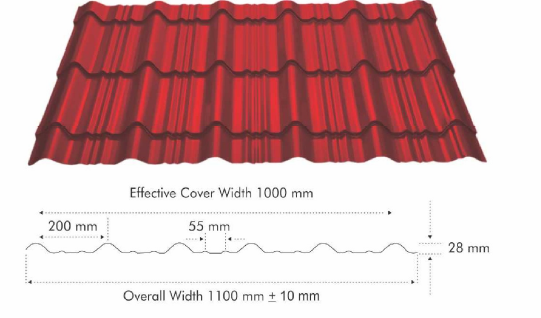
| Covered Width | 1000 mm |
|---|---|
| Supply Width | 1060 mm |
| Pitch | 200 mm |
| Crest Height | 29 mm |
| Crest Width | 24 mm |
Pre-Painted Galvalume
| Thickness (TCT) | 0.30 to 080 mm |
|---|---|
| Substrate | Galvalume (55% Aluminium-43% Zinc Coating 70 to 200 gsm) |
| Output Sheet Length | As per requirement |
| Coating Material | Regular Modified Polyester (RMP) |
| Primer Coating Thickness | Top = 7µ max, Bottom = 7µ max |
| Finish Coating Thickness | Top = 25µ max, Bottom = 5µ max |
| Colours | As per RAL Code / Customer Requirement |
| Profile Available | Trapezoidal Double Ribbed |
| End Use | Roofing & Cladding-Domestic, Industrial, Warehousing etc., |
Pre-Painted Galvalume
Popular Questions
Storage and Handling
If colour coated sheets are to be stored for any time prior to forming or installation, they must be stored in dry, well ventilated conditions. Storage which allows water (including condensation) to be trapped between the sheets may damage the coating beyond repair
Some Do’s and Don’ts that needs to be followed as below:
DO’s
- Storage yard should be properly covered.
- Material should be kept in clean, dry, shaded, good ventilated and plain surface condition.
- Packing and storage area must be cleaned regularly in order to avoid accumulation of dust and debris.
- Always clean your hands and use a hand sanitizer before handling Tin plate / Tin free product.
- Use clean and dry hand gloves to protect the surface of the sheet.
- Storage and packing area should be free from any form of water contact. In case of presence of water, the sheets must be separated, cleaned and completely dried before using.p>
- Once the packets/coils are opened, they must be used immediately and should not be held open for a long time without processing
- Material must be stored indoor on the wooden blocks as suppplied.The storage area must not be humid.
- Personal hygiene to be maintain for handling of Tinplate products.
- Rotation on a First-In, First-Out (FIFO), and First-Expired, First-Out (FEFO) basis, whichever applicable
DON’Ts
- It is recommended to stack the packets/Coils. The packets must not be stacked over a 6 layer level and the coils must not be stacked over a 3 layer level.
- It is recommended to use the Tin plate / Tin free product within six month ( In packed condition) for Food packaging.
- Do not reuse the Tin plate / Tin free products for food safety
- It is recommended to avoid using Defective / Non Standard materials for food-grade applications, as these materials may not meet the quality standards required for products intended for human consumption.
- Under no circumstances should the material be stored near or come in contact with salt water, corrosive chemicals, ash, or fumes generated or released inside the building or nearby plants, foundries, plating works, kilns, fertilizer, and wet or green lumber
Avoiding White Rust to avoid corrosion
The most common causes of White rust to be considered to avoid corrosion are

Ingress of water in a stack of colour coated sheets to be avoided

Condensation within a coil or sheets due to rapid changes in temperature

Prolonged/adverse storage or inadequate protection during transportation allowing considerable water ingress between stacked coils or sheets results into red rust
Maintenance
All roofing and cladding products are exposed to the external factors and effects of weather, dust and other deposits. Like any material that’s exposed to the elements, a little bit of maintenance is always required that will help your steel Roof and Cladding lasts longer.
Maintenance involves the following:
Regular washing
Regular washing every 3 to 12 months (depending on the local environment). This helps to prevent the build-up of dirt, debris or other materials that are not otherwise removed by rain washing.
Regular Inspection
Regular Inspection of the Wall to ensure non accumulation of dust and other unwanted material